

What's Left After the POGO Ban? Over 9,000 Foreigners Who Can't Go Home, and Perhaps 10 Times That in Scam Hubs in Residential Neighborhoods
POGO (Philippine offshore gaming operators) was banned, and the number of licenses went to zero. But the people did not disappear. Thousands of Chinese who can't go home remain, hubs have scattered into small houses in residential neighborhoods, and Filipinos have been sent out to scam hubs abroad. Authorities explain that part of the operations moved to Cambodia and other countries.
Japanese people are at the other end of this as well. But the cases involving Japanese that can be confirmed in the Philippines are few compared with Cambodia.
The people left after the ban
On July 22, 2024, President Marcos declared the ban in his State of the Nation Address. Executive Order No. 74 on November 5 set a complete shutdown within the year. On December 31, PAGCOR (the Philippine Amusement and Gaming Corporation) revoked all 42 licenses plus the licenses of 18 service providers, and closed 304 sites (PNA). Under Republic Act No. 12312, signed on October 23, 2025, the ban became permanent, and violations carry up to 12 years in prison and a fine of up to ₱50 million (Inquirer).
So what happened to the people who worked there? According to the Bureau of Immigration (BI), of 33,000 registered POGO workers, 11,254 were still in the country as of February 2025. 121 had been deported, 518 arrested and 45 had surrendered (ABS-CBN).
On June 9, 2025, the executive director of PAOCC (the Presidential Anti-Organized Crime Commission) told the House that more than 9,000 illegal foreign workers were still in the country. Detention facilities were overcrowded, and many of the more than 640 people held had no passports and could not be deported. Raids on those roughly 9,000 people were put on hold (ABS-CBN).
Why they can't go home
Foreigners who worked at POGO had their passports taken and are scattered across the country, the executive director explained. Some come to PAOCC for help because their embassies turn them away without a passport (same ABS-CBN article).
Some don't have the money for a plane ticket. In July 2025, PAGCOR gave the BI ₱50 million for deportation costs (Philstar). Others are afraid to go back to China. The 84 people deported to China in April 2025 were questioned by the authorities there. According to the executive director, some people fear returning because in China they are not treated as victims and could face criminal cases (Philstar).
Not all of them are serious criminals. Senator Gatchalian said some have partners or children and are simply staying (Inquirer). Deportations also continue. In 2025, the BI deported 98 Chinese in February, 84 in April, 100 in June and 91 in September.
Even so, the number still here is unknown. In October 2026, a former PAOCC spokesperson said that 509 foreigners linked to POGO and scam hubs were apprehended between February and October of that year, most of them Chinese. But he said that may be less than 10% of the real number, and that they did not leave the country, they just hid under the radar. This is a former official's estimate, not an official statistic (ABS-CBN).
From big compounds to small houses in residential areas
After the ban, the hubs got smaller. In October 2024, the Department of Justice described the raids in Ayala Alabang Village, an upscale neighborhood in Muntinlupa, as follows: the shrinking from big compounds to small groups in residential areas is a "natural trend" after the ban, and a "last gasp" before leaving the country (Inquirer). PAGCOR told the Senate that it used to be able to inspect at any time, but now it has to coordinate with cities, towns and building administrators, and is restricted (PNA).
Rappler also reported the landlords' side. Houses in this neighborhood rented for ₱100,000 for one bedroom, and ₱500,000 a month in cash for a five-bedroom. The normal rate is ₱250,000. At first they were rented as a family home, then months later became a staff house for 40 to 50 people, and when the neighbors complained they rented the house next door (Rappler). The PAOCC executive director explained that a small hub is 20 to 50 people renting two rooms (Inquirer).
Here are the main raids reported in 2025–26.
| When | Where | What happened |
|---|---|---|
| July 2025 | Mandaue City, Cebu, inside a residential area | 9 Chinese arrested on suspicion of human trafficking. Filipino workers were also held against their will (GMA) |
| November 2025 | Bacoor, Cavite, an ordinary house | 8 Chinese arrested (Tribune) |
| February 2026 | Muntinlupa | 8 Chinese arrested. A Chinese male victim was held for about 2 weeks and given electric shocks (Philstar) |
| March 2026 | San Pedro, Laguna, inside a residential area | More than 30 Filipinos arrested. They posed as a call center and targeted elderly people in the US (ABS-CBN) |
| April 2026 | Parañaque, a condominium | 48 arrested, 41 of them Filipino women. Romance scams and crypto investment scams (Philstar) |
| April 2026 | Angeles City, Pampanga, a house | 3 Chinese arrested. The director of the NBI (National Bureau of Investigation) called it a small "kitchen-type" operation and said it was a group that split off from an original large POGO (GMA) |
| Early October 2026 | Zamboanga Sibugay | 244 foreigners arrested. The largest raid since the ban. About 3,000 mobile phones seized (Inquirer) |
| October 12, 2026 | Quezon City | 76 arrested: 74 Chinese and 2 Myanmar nationals (Manila Times) |
There are also cases of Filipino former employees going independent. In June 2025, the head of the police Anti-Cybercrime Group (PNP-ACG) said that many of the cybercriminals caught recently are former POGO employees working independently, so they can no longer be called linked to POGO. The secretary of the Department of Information and Communications Technology (DICT) said he would not be surprised if people who lost their jobs turned to financial crime or hacking (ABS-CBN). How the small hubs inside the country recruit people has not appeared in the reports.
Filipinos are sent abroad
The flow of people also heads overseas. In February 2025, a BI spokesperson explained that the POGO side pays some call center employees to become "brand ambassadors," who lure fellow BPO (business process outsourcing) workers to hubs abroad. They are promised a monthly salary of ₱50,000. They enter Thailand as tourists and are carried across the border to Cambodia, Myanmar or Laos. On arrival their passports are taken, and to leave they need a release fee of about ₱400,000, which the spokesperson called debt bondage (same ABS-CBN article).
The number of those who came back from abroad is also available. According to the Department of Migrant Workers, 1,454 people returned over the two years from 2024 (Cambodia 376, Laos 399, Myanmar 764) (Philstar). From January to July 2026 it was 1,293, and 89% had been forced to commit crimes (UCA News).
The hubs moved to Cambodia
Cambodia's scam hubs also began with casinos for Chinese customers and legal online gambling. According to the GI-TOC (Global Initiative Against Transnational Organized Crime), Cambodia banned online gambling under Chinese pressure in 2019, and when COVID stopped the customers coming, the buildings of the casino towns turned into scam hubs (GI-TOC).
After the Philippine ban, PAOCC explained in February 2025 that some illegal POGO workers were moving to Cambodia and elsewhere to restart operations (abogado.com.ph). There are no numbers showing how many moved to which hubs. In April 2025, the UN Office on Drugs and Crime (UNODC) put the annual profit of the scam hub industry in East and Southeast Asia at just under $40 billion, and wrote that under crackdowns it is spreading to surrounding areas "like a cancer" (UNODC).
Japanese people were there too
Japan's National Police Agency's Police White Paper describes tokuryu (anonymous, fluid criminal groups) like this: groups that recruit disposable foot soldiers for "high-paying part-time jobs" on social media, then hold the applicants' personal information and threaten them into obeying (Police White Paper).
Looking overseas, according to the National Police Agency, there were 544 cases between October 2024 and November 2025 in which people who applied for "dark part-time jobs" (yami baito, crime recruited as side gigs) were taken into protection by police. In most cases where people were told to act as callers (kakeko, the people who phone victims), they had been recruited to hubs overseas such as Cambodia (Nippon TV News NNN). In May 2025, 29 Japanese were taken into custody in Poipet, Cambodia, and in August they were transferred to Japan and arrested. Statements from those who returned reported violence such as being beaten and kicked, having arms cut with a knife, and nails pulled out. Pay at the hub went to living costs and the like, and at most they came home with about ¥2,700 in their pockets, and many had gone to repay debts (Yomiuri Shimbun, Nikkei). In June 2026, a National Police Agency official said there may be dozens of Japanese missing in Cambodia (Asahi Shimbun).
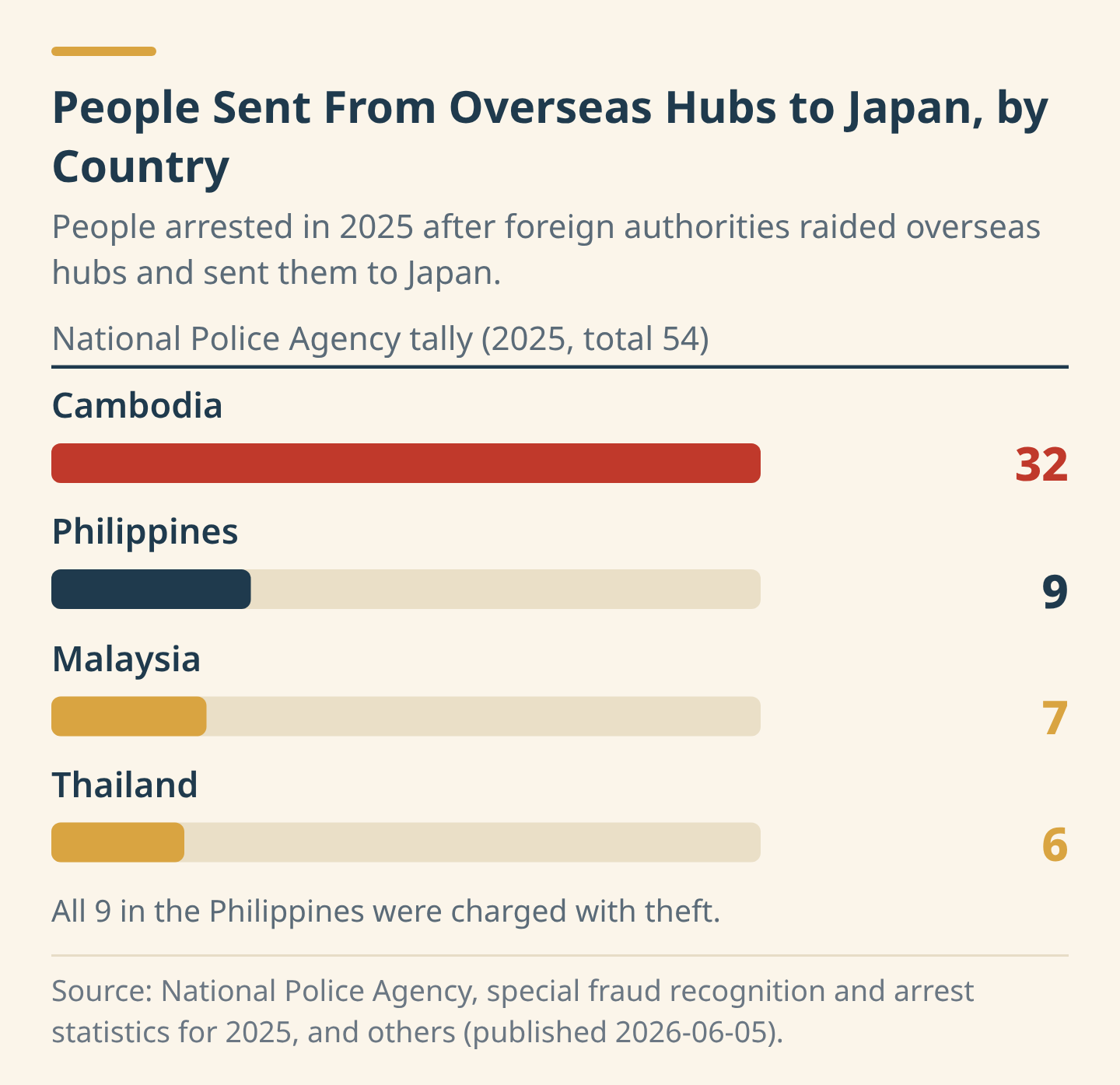
According to the National Police Agency's tally, 54 people were arrested in 2025 after overseas hubs were raided by foreign authorities and they were transferred to Japan. By country: Cambodia 32, the Philippines 9, Malaysia 7, Thailand 6. The charge for all 9 in the Philippines was theft (National Police Agency).
One case confirmed in the Philippines is "JP Dragon." According to Fukuoka prefectural police, the group made calls to Japan from a two-story house in Bulacan (nicknamed the Pink House), posing as police officers. The list of about 200,000 people they seized was almost all people aged 80 and over, and their hours of activity ran from 9 a.m. to late afternoon, when police offices are open (Yomiuri Shimbun). The BI detained 6 members of this group in May 2025 and deported them in September (BI).
In February 2026, 3 Japanese and 1 Chinese were arrested in Angeles City, Pampanga. It began with a tip to the Japanese embassy. Two Japanese escaped from a scam hub in Clark and asked the embassy for help, and of 10 people who had worked at a hub in Cambodia, 5 are said to have been moved from Cambodia to Clark with a Chinese person's help. The 4 who were arrested admitted involvement in the fraud but denied kidnapping and extortion (Inquirer, BI). The reports don't say who they were targeting. I also found no report saying that hubs run by former Chinese POGO operators target Japanese.
People who can't go home
Statements from people forced to work at overseas hubs appear in National Police Agency materials. One says their passport and phone were taken, and they were told to pay millions to go home. Another says that when they said they didn't want to commit fraud, they were threatened with having their organs sold and their family killed. Another says that mistakes were met with violence, and in the worst cases they were doused in alcohol and set on fire. In May 2026, Japan's Ministry of Foreign Affairs also warned that in "dark part-time jobs" abroad, it is not rare for people to have their passport and phone taken and be unable to escape the hub for a long time (Ministry of Foreign Affairs).
At a hub in Porac, Philippines, in June 2024, PAOCC received a report that a man who appeared in a video of being beaten had died (Inquirer). I could not confirm any case of a Japanese person dying, in the Philippines or in Cambodia. And plenty of people have made it home through deportation.
Still, in the Philippines there are people who have no passport, may face charges if they go home, and cannot afford a plane ticket. Some of them, I suspect, still can't eat without cheating someone. And somewhere in this country, I suspect, there are people who can't go home until they are caught or die. There are no statistics I can verify. But that is what I think.