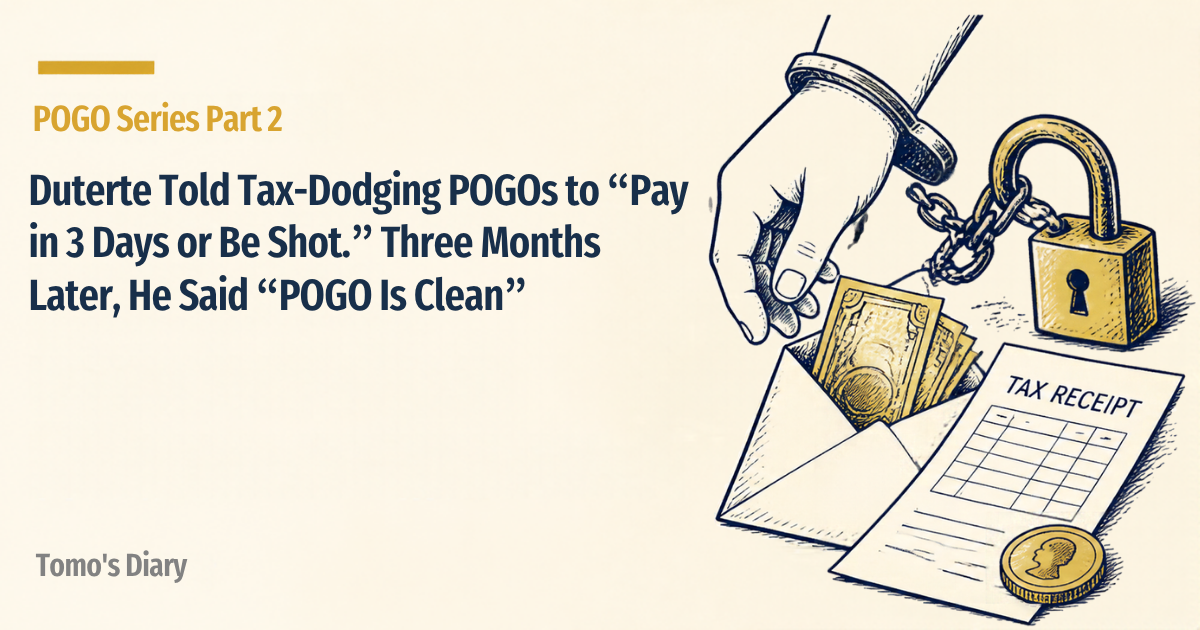
Duterte Told Tax-Dodging POGOs to "Pay in 3 Days or Be Shot." Three Months Later, He Said "POGO Is Clean"
After the number of Chinese workers at POGO (Philippine offshore gaming operators) grew, kidnappings of Chinese by Chinese rose in the Philippines, suspicions of bribes over entry into the country surfaced, and tax revenue fell short of what people expected.
President Duterte got angry about taxes, and told people involved in crime, "I'll kill you." A few months later he said, "POGO is clean." The one who decided on a ban was the next president, Marcos.
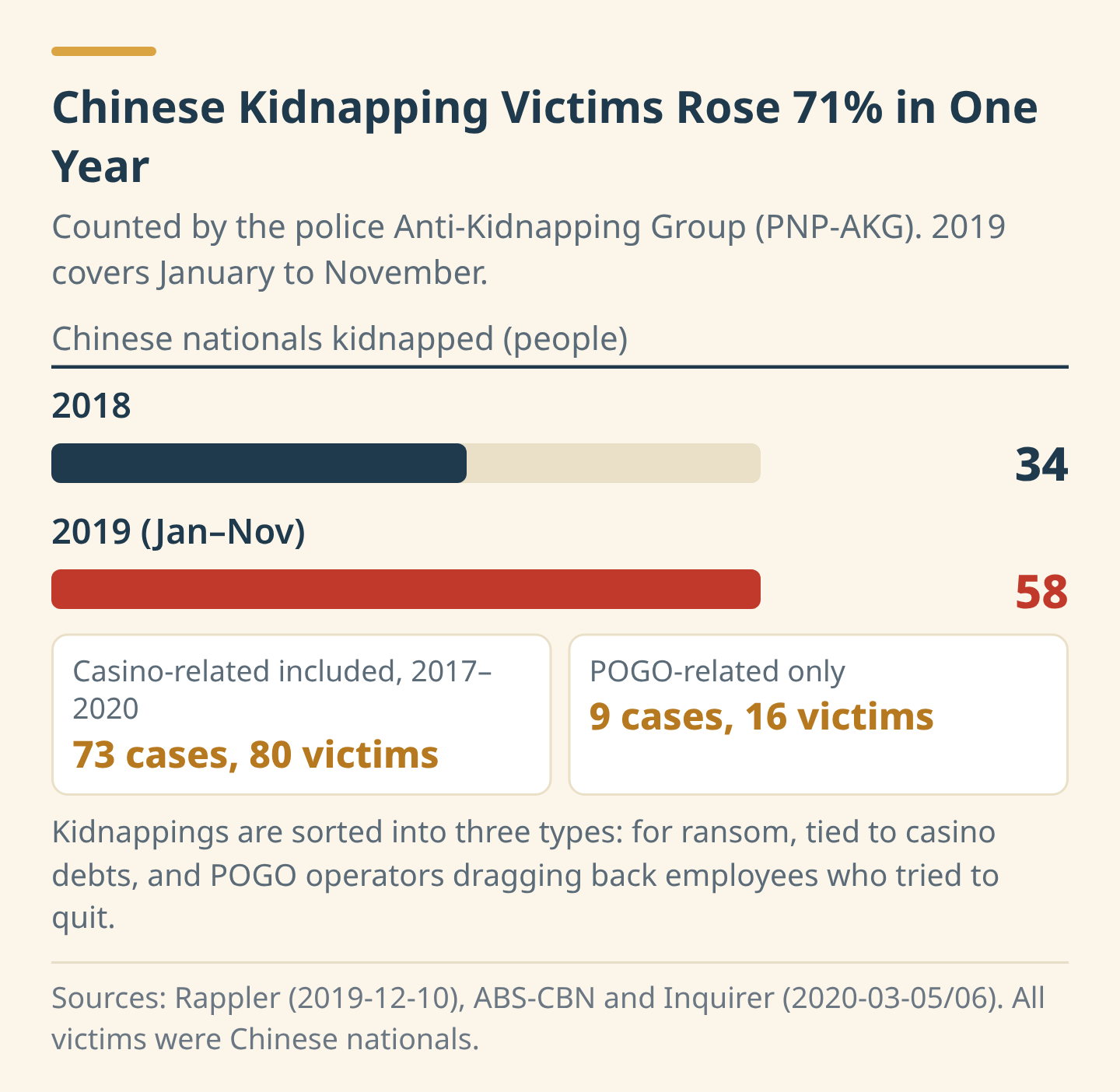
Kidnappings rose 71% in a year
According to a count by the police Anti-Kidnapping Group (PNP-AKG), 34 Chinese nationals were kidnapped in 2018, and 58 in 2019 through November. That is a 71% increase (Rappler). The AKG sorts kidnappings into three types: for ransom, tied to casino debts, and POGO-related. Rappler explains that POGO-related means a new tactic in which a POGO company drags back an employee who tried to quit.
At a Senate hearing in March 2020, a deputy chief of police laid out the numbers. Casino-related kidnappings were 17 in 2017, 16 in 2018 and 38 in 2019. Across 2017 to 2020 the total was 73 cases, and all 80 victims were Chinese (Inquirer, ABS-CBN). Narrowed to POGO-related cases, it was 9 cases, 16 victims and 38 suspects.
There are numbers on prostitution rings too. In 2019, 199 women were rescued from prostitution rings run by Chinese, and 173 of them were Chinese. Of the 60 people arrested, 59 were also Chinese. The deputy chief said the rise in crime depends directly on the number of Chinese entering the country (ABS-CBN). The Chinese embassy in Manila, for its part, pushed back that these were individual cases and did not represent the whole picture.
₱10,000 a head to get in
In February 2020, Senator Hontiveros presented suspicions of bribery over entry into the country in the Senate. According to an informant, a Chinese person arriving on a tourist visa pays ₱10,000 per head. Of that, ₱2,000 is split among airport immigration officers, and ₱8,000 goes to the Chinese side, domestic operators and criminal groups. Because the cash is wrapped in paper when handed over, the senator called the scheme "pastillas" (Rappler).
An official of the Bureau of Immigration said it was the first he had heard of it, and announced an investigation. In February, President Duterte relieved 19 immigration officers of their duties over this (Philstar). The amounts and the mechanism rest on an informant's account, and I found no report saying they were confirmed.
Tax revenue didn't come in as expected
In December 2019, a BIR (Bureau of Internal Revenue) official told the House that of 50 POGOs based overseas, none had paid the 5% franchise tax. Only 10 domestic companies had paid (Philstar).
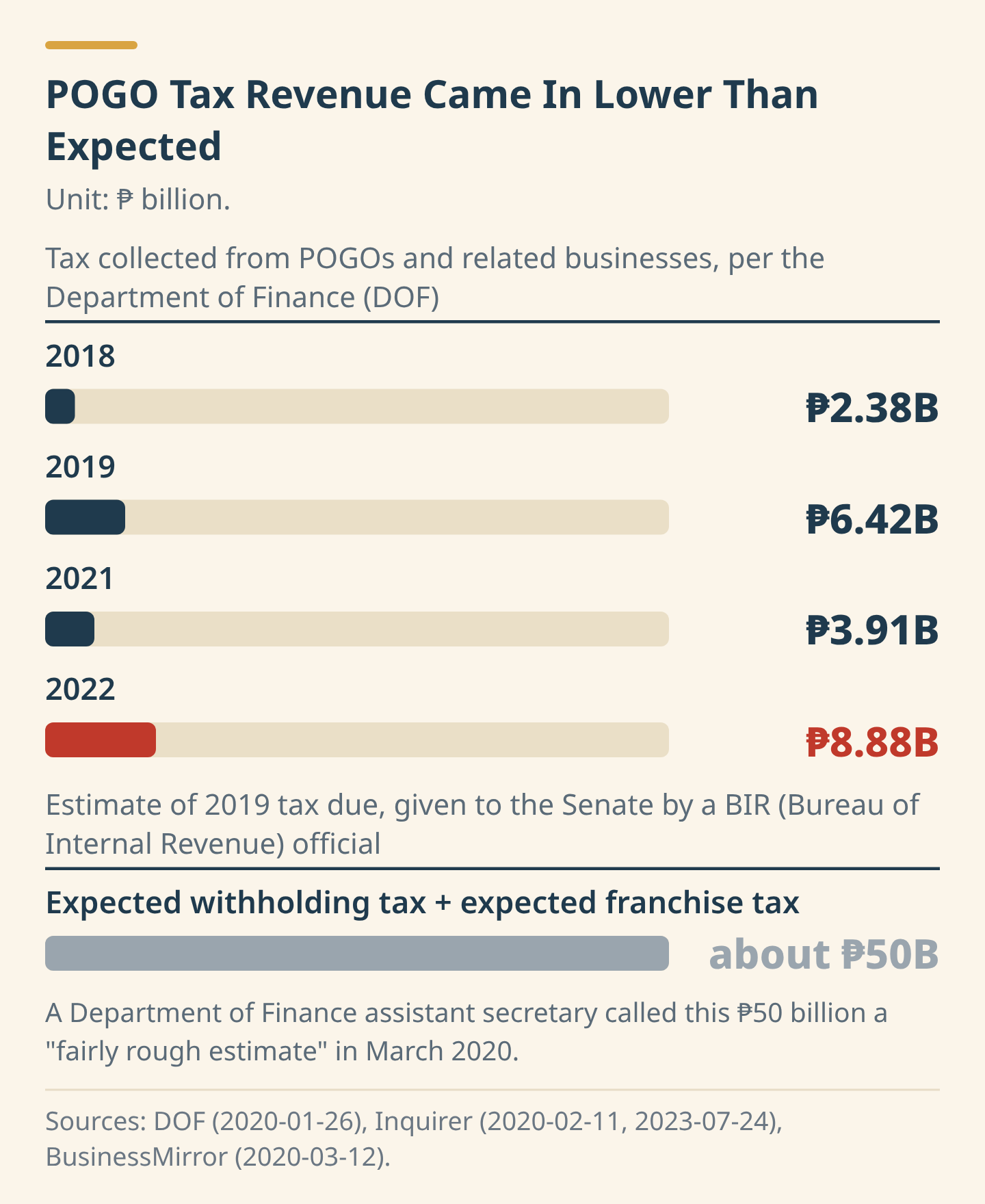
In February 2020, another BIR official told the Senate that the tax licensed POGOs should have paid in 2019 was roughly ₱50 billion. That broke down to about ₱30 billion in withholding tax and ₱17 to 18 billion in franchise tax. What the BIR actually collected was about ₱5 billion (Inquirer).
But the Department of Finance admitted the next month that this ₱50 billion was a "fairly rough estimate" and may have been too high (BusinessMirror). By the Department of Finance's count, the tax collected from POGOs and related businesses in 2019 was ₱6.42 billion, up 169% from ₱2.38 billion the year before (Department of Finance). In 2022 it was ₱8.88 billion (Inquirer).
In the Senate, the minority leader pressed PAGCOR (the Philippine Amusement and Gaming Corporation). The government's fees come to only ₱8 billion, he said, and you would keep POGO for that? (ABS-CBN).
Duterte got angry, then said "It's clean"
On August 30, 2019, at a business forum in Beijing, President Duterte said Chinese people are kidnapped by loan sharks over casino debts and sometimes killed. Then, speaking to people involved in crime, he said that if you destroy this country with drugs or cocaine, I will kill you, that's it. He also said he would protect law-abiding businesspeople (GMA).
His anger showed most clearly over taxes. In a television interview on November 29, he told POGOs that didn't pay taxes that they had at least three days, or he would shoot them with bombs. He went on to say he would beat anyone who cheated Filipinos. Ten days later, at a House hearing, the BIR testified that of the 50 overseas-based POGOs, none had paid (Philstar).
A little over three months later, at a meeting of city and town mayors on March 10, 2020, the president prefaced it with a guarantee under oath and said POGO is clean. He also said POGO puts ₱2 billion a month into the country's coffers, and PAGCOR ₱17 billion a year (Philstar). ₱2 billion a month is ₱24 billion a year. The tax the Department of Finance announced it collected in 2019 was ₱6.42 billion, so they may not be counting the same thing, but there is a gap.
Marcos declared the ban
On July 22, 2024, in his State of the Nation Address, President Marcos said that effective today, all POGOs are banned. He said they had disguised themselves as legitimate businesses and spread into illegal areas far from gambling, and listed financial scams, money laundering, prostitution, human trafficking, kidnapping, brutal torture and murder. He ordered PAGCOR to shut them down by the end of the year (Philstar). That article also reports that the Department of Finance had estimated the country would lose about ₱99.5 billion a year if POGO were left alone.
President Duterte got angry about taxes, told people involved in crime "I'll kill you," and in March 2020 declared "POGO is clean." A little over four years later, President Marcos declared that the industry was "all banned." Two presidents described the same industry in opposite words, and in between they left 80 kidnapping victims, suspicions of bribes over entry, and tax figures that don't match. To me, that mismatch says the most about what POGO was.