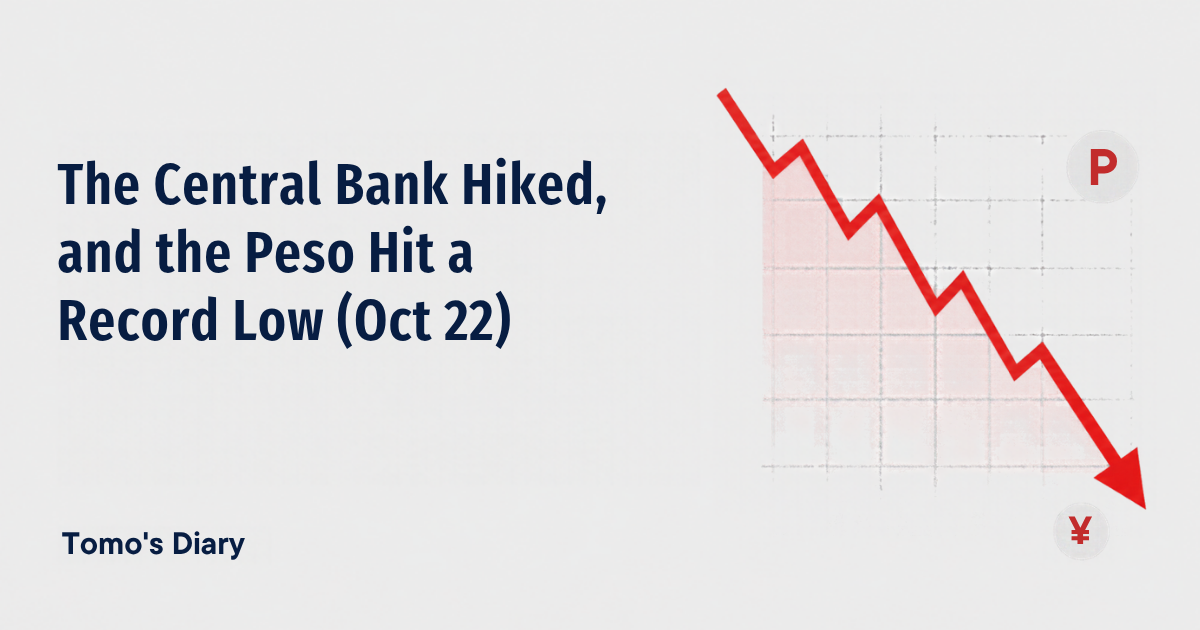
The Philippine Central Bank Hiked Rates, and the Peso Hit a Record Low the Same Day (Oct 22)
I take on remote work from a Japanese company, so I earn in yen and live on Philippine pesos. That makes the yen-peso rate the number I care about most every morning. On October 22, that rate moved in a strange way.
Rate hike day
On October 22, the BSP (Bangko Sentral ng Pilipinas, the Philippine central bank) raised its policy rate (the benchmark interest rate a central bank sets) by 0.5 percentage points to 5.5%. Apparently it was a bigger hike than the market had expected.
Normally, raising interest rates makes a country's currency more attractive to buy. With prices rising in the Philippines right now, it should also have been a move that helps stop the peso's slide.
The peso still hit a record low
Yet that day the peso closed at 63.52 to the dollar, a new record low. During trading it sank as far as 63.545 (Inquirer). It broke the record low it had set only the day before.
According to the article, there were two main reasons:
- After U.S. inflation data, expectations grew that the Fed (the U.S. central bank) would raise rates again, and investors bought dollars
- Oil prices rose because of the conflict in the Middle East, and the Philippines, which relies on imports, needs more dollars
Even a 0.5-point hike couldn't stop the strong-dollar trend.
The yen, meanwhile, went the other way and was bought. A sell-off in AI-related stocks strengthened the risk-off mood and drove demand for the yen as a safe-haven currency, and falling U.S. interest rates narrowed the gap between Japanese and U.S. rates (FXStreet). By the ECB (European Central Bank) reference rate, October 22 came in at ¥10,000 = ₱4,044 (¥1 = ₱0.4044), the strongest the yen had been in a month (Frankfurter/ECB). A month earlier, on September 22, it was ¥10,000 = ₱3,974, so the same ¥10,000 now gets you about ₱70 more.
For someone who earns in yen and lives in pesos, a weak peso and a strong yen on the same day made it a great day to exchange money.
But prices are rising
I can't just celebrate, though. According to the PSA (Philippine Statistics Authority), September's CPI (consumer price index) was up 7.2% year on year, and rice was up 20.3% (PSA).
A weak peso feeds straight into the prices of anything that depends on imports.
- Meralco (the electric utility serving Metro Manila) raised its October rate to ₱15.06 per kWh. For a household using 200 kWh, that's about ₱64 more a month. Meralco itself lists the weak peso as one of the reasons for the increase (Meralco)
- LPG (bottled propane gas for home use) went up by as much as ₱190.60 per 11 kg tank in October, according to the Department of Energy (DOE)
When you get paid in yen and convert to pesos, a weak peso means more money in your pocket. But the weak peso is also pushing up prices here, and I buy rice and use electricity here too. Getting to exchange on a strong-yen day isn't something I can celebrate without reservation.
Where the gains end up
On the day the central bank raised rates to defend its currency, the peso hit a record low, and the one who came out ahead was me, earning in yen. That's ₱70 more per ¥10,000 than a month earlier, but the weak peso is also listed among Meralco's reasons for raising its rates. For a household using 200 kWh, ₱64 of that goes straight back to Meralco as the electricity bill.