Use Autonomous Agents Dots and Grok Bot for Different Jobs
In the AI price war, the gap between the models themselves has all but disappeared. So every company is trying to lock customers in with conditional discounts and always-on agents. I thought I'd been careful not to get caught. Apparently, I'm not just a bystander.
Rippling has been moving to OpenAI since May
According to a report by The Information on October 24, Anthropic's models handled 57% of the coding work done by engineers at HR software company Rippling in May, while OpenAI's handled 16%. Now it's flipped: OpenAI at 52%, Anthropic at 18%. CEO Parker Conrad pointed to OpenAI being cheaper (free excerpt).
Replit, which lets you build apps in the browser, reportedly moved most of its AI spending to OpenAI after getting more than 30% off (Techmeme summary).
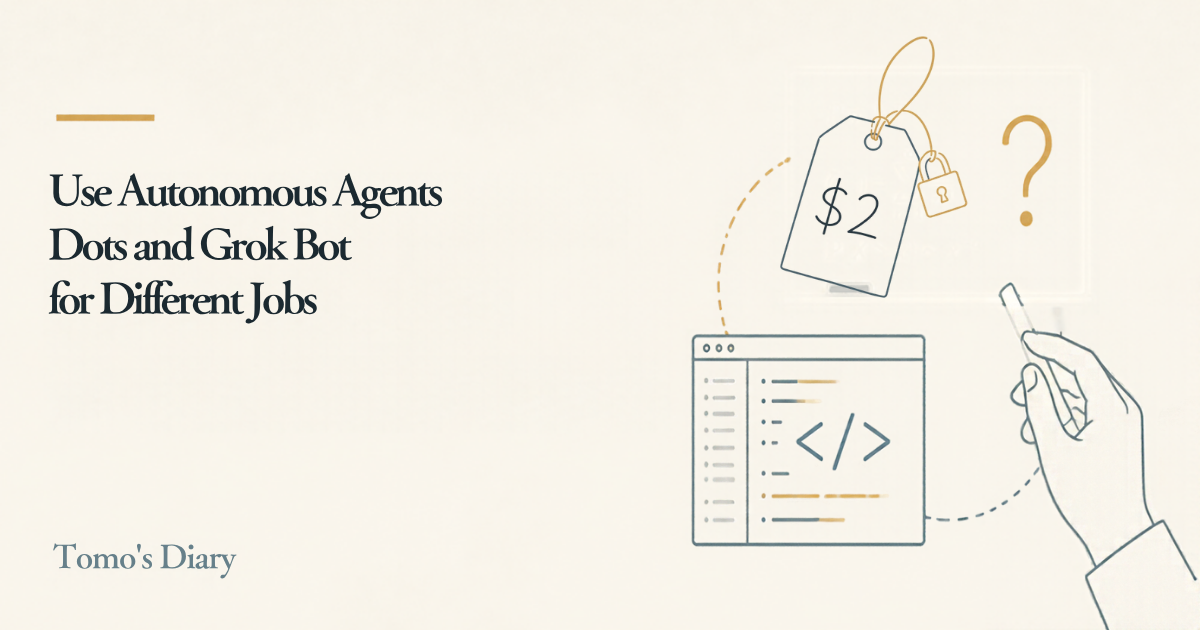
Every list price is $2
Line up the API (the way programs call an AI model) list prices and it's almost anticlimactic.
- OpenAI GPT-6.1 Sol: $2 input, $10 output (official)
- Anthropic Claude Sonnet 5.5: $2 input, $10 output (official)
- Moonshot Kimi K3.1 Pro: $2 input, $10 output (per Artificial Analysis)
Those are per million tokens (the units AI uses to count text). In yen that's about ¥314 in and ¥1,568 out; in pesos, about ₱127 and ₱636. Identical.
Every AI can now drive a terminal, has its own VM (virtual machine), and runs agents in the cloud. There are even decision models built only for judging and classifying: Microsoft's Decision-1 costs $0.042 per million input tokens, and output is free. Cheap LLMs (large language models) running on your own machine return answers with usable quality and speed.
For software development, today's Opus or Sol is plenty. There's no need to keep paying for a top-tier model like Mythos. Even the free Muse model is enough.
Locking you in with conditions and ecosystems
Since no one can hold customers with a model alone, the companies are trying other ways.
One is the conditional discount. The Information's article says OpenAI also offered a discount to online learning company DataCamp. In a screenshot of the article posted by The Information's Amir Efrati, one line reads "...use Codex rather than a competing tool like OpenCode or Claude Code." The sentence is cut off, but it appears the discount was tied to using Codex, OpenAI's AI coding tool.
The other is the ecosystem. OpenAI launched Daybreak, which works with Codex to find security holes in your code and prepare fixes. Always-on AI has arrived too: OpenAI's Dots (autonomous agents that keep working 24/7 on their own cloud computer) and Anthropic's Claude Duet (an agent that sends a morning brief and handles tasks in the background).
I split them by direction
To avoid getting tied to one company, I divide my AI by which way the work faces.
- Inside (actions from Slack and email): OpenAI's Dots
- Making things (writing code, creating documents): Claude
- Outside (actions on trends from X and the news): Grok Bot
No single AI wins in every direction. A conditional discount like DataCamp's is a way of getting you to hand an entire direction over to one company.
What choosing by cost, speed, and quality got me
I've long said: choose your model by cost, speed, and quality. Pick each agent for its role on those three, and I'd never be locked in. That was the plan.
But once you've lived with an always-on agent, you can't leave. I split my AI to avoid being locked in by one company, and got locked in by all three.
Claude's Max plan is $200 a month; Grok and OpenAI are $100 each. In the middle of a price war over $2 list prices, I'm paying three companies $400 a month (about ¥62,700, or ₱25,500).